UX Research · AT&T · 2022
Closing AT&T's Wireless Trust Gap
My Role
Principal UX Researcher
Scope
Wireless Upper Funnel — att.com
Key Partners
Digital Sales Team
Brand Strategy Team
Summary
I led UX Research efforts that identified the causes of a decline in online sales performance and slumping web customer satisfaction scores. My team's recommendations bolstered customer satisfaction and achieved measurable commercial results.
+19%
Click-through Rate (CTR)
+13%
Conversion Rate (CVR)
One of the best-performing A/B tests across the site in several years.
The Problem
AT&T needed to resolve a decline in trust and customer satisfaction with the wireless sales season approaching fast.
In 2022, AT&T's Web Satisfaction Score fell 19 points over two quarters — more than any major carrier in the wireless industry. The Digital Sales team saw a concerning number of online shoppers abandoning the sales flow early in the customer journey, just one quarter ahead of the company's biggest annual sales event.
In parallel, the AT&T Brand Strategy team raised concerns that the online channel was not aligned to AT&T's brand voice but had no way to measure that alignment.
The Digital Sales and Brand Strategy teams approached the CX Research team seeking insight into the current situation and a path to course-correct before the make-or-break sales season arrived.
The Approach
A four-phase research initiative, featuring the first brand voice benchmark in AT&T's history.
I was assigned a junior researcher to assist with the initiative. After reviewing all available data, we outlined a four-phase approach to baseline the current state and identify the best path forward.
Quantitative Survey
Qualitative Interviews
Competitive Analysis
Experimentation
The survey established a baseline for how customers perceived the three major wireless carriers across core brand metrics and benchmarked their respective web experiences. We devised a methodology for measuring alignment with AT&T's Brand Voice — the first-ever of its kind at the company. The survey also benchmarked critical facets of the upper funnel experience against the major carriers to identify strengths and weaknesses in AT&T's current state.
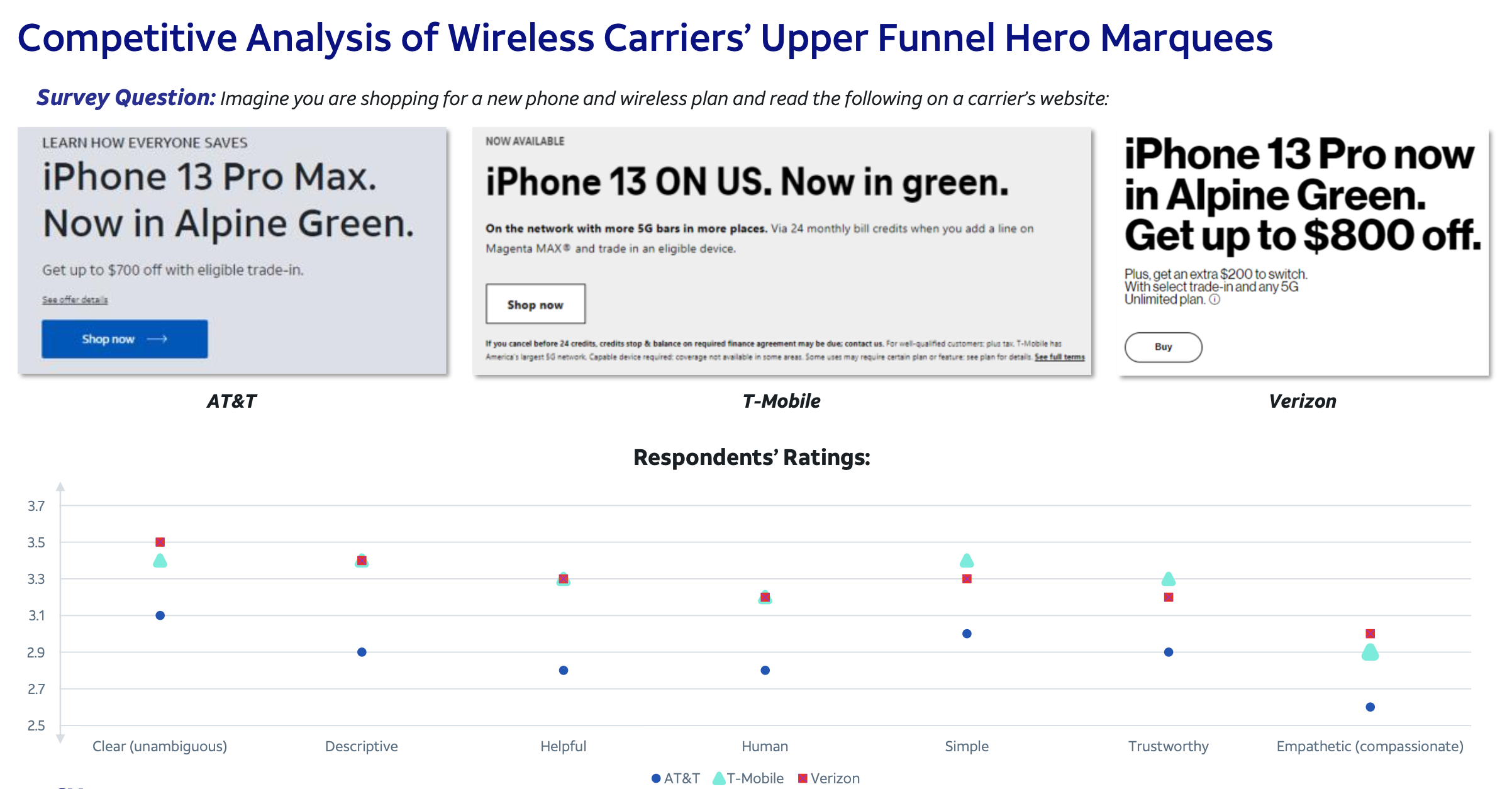
The brand voice was benchmarked by distilling AT&T's core brand principles into measurable attributes that respondents scored on a Likert scale. Previously abstract ideas, like "Sounding Human" or feeling "Empathetic," were now quantifiable across any customer-facing asset — from a TV ad to copy on the website.
Findings
A trust deficit was compounded by opaque pricing.
- •1 in 3 participants did not trust the wireless industry and carried baggage from past experiences.
- •AT&T's upper funnel copy underperformed the major carriers across all measured attributes: Clarity, Descriptiveness, Helpfulness, Sounding 'Human,' Simplicity, Trustworthiness, and Empathy/Compassion.
- •Consumers found AT&T's pricing opaque and the terms of its offers vague.
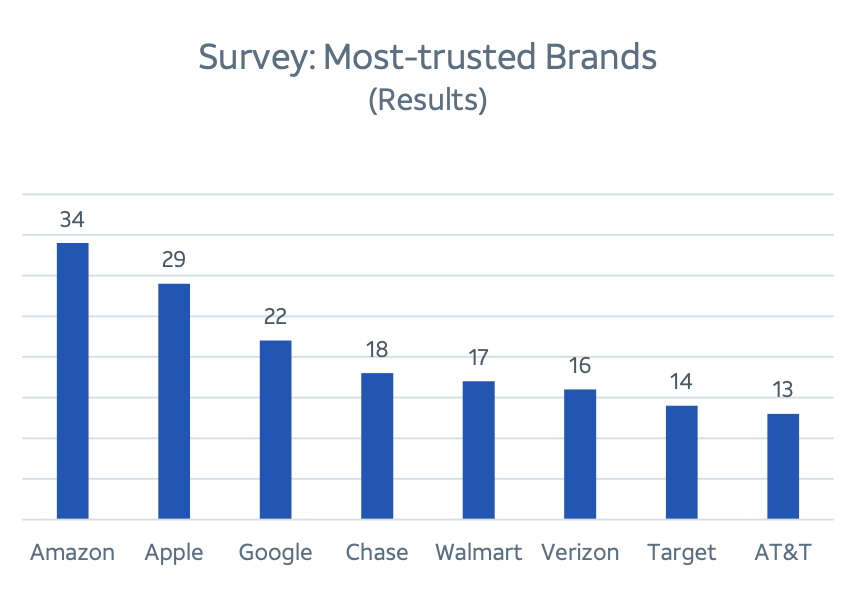
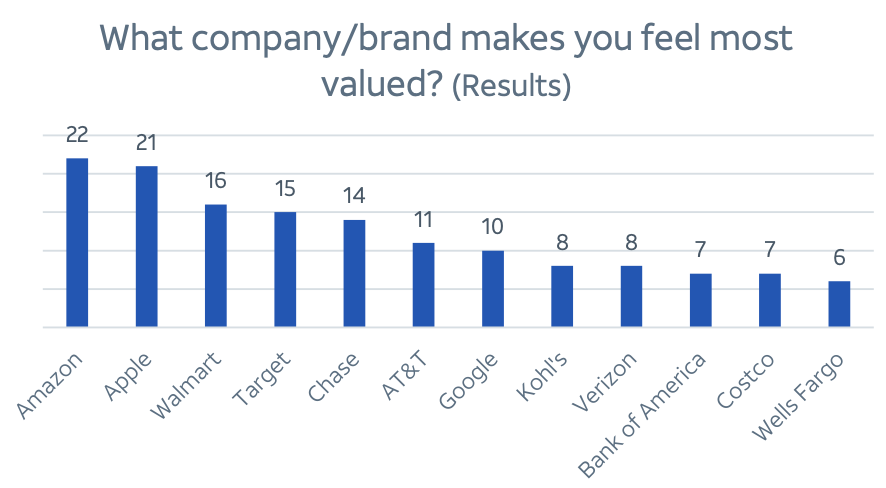
The qualitative interviews brought these numbers to life. Across moderated sessions, we repeatedly heard a version of the same concern:
"It seems like information is being withheld, which makes me not trust AT&T... You say '$700 off' — but off of what price?"
— Research participant
T-Mobile and Verizon's transparency provided clear pricing and eligibility details upfront, and customers perceived them as more trustworthy for doing so.
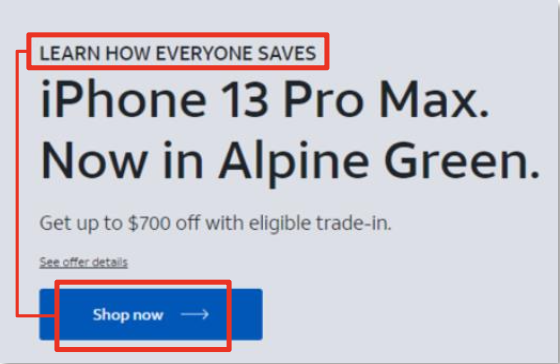
The qualitative interviews also identified that AT&T's calls-to-action were misaligned with customer intent. On the "Learn How Everyone Saves" marquee, the only CTA was "Shop Now," which frustrated customers seeking clarity about the vaguely-worded offer — and directly contributed to AT&T's low trustworthiness and simplicity scores in our survey.
Competitive Analysis
Marketplace leaders provided clear guidance.
The competitive analysis confirmed our direction and provided north stars for our stakeholders to reference.
Apple
Showed the full retail price and monthly payment side by side — "From $41.62/mo. for 24 mo. or $999 before trade-in" — with two separate CTAs aligned to different customer intents.
Chase
Faced a similar challenge — making big-ticket purchases feel manageable — and communicated with empathy, demonstrating awareness of consumers' needs and winning trust with consumers.
Notably, neither brand hid information at the outset. Customers had no reason to fear a bait and switch — and their trust scores reflected it.
Our Recommendations
We presented a three-pronged strategy to our stakeholders.
Embrace transparent pricing.
Remove hidden fees and state the full cost of the device upfront, ensuring offers are clear and unambiguous. This would help AT&T overcome its trust deficit and give customers confidence to proceed from the upper funnel into the buy flow.
Align CTAs to intent.
Not all customers are ready to "Shop now" — some needed a way to "Learn more" if they had questions.
Connect to the customer with empathetic language.
The wireless shopping experience was a big ticket purchase that stressed some households' finances, but our copy was cold and indifferent. The highest-performing copy in the marketplace acknowledged the stakes of the purchase and showed awareness towards customers' needs. AT&T's own brand guidelines called for customers to feel "understood, valued, and appreciated," but our research discovered that copy wasn't delivering that.
Outcome
One of the best-performing A/B tests in years.
The Digital Sales and Brand Strategy teams worked together to overhaul the upper funnel with our recommendations and ran an A/B test. The variant increased click-through rate by 19% and conversion rate by 13%, and bolstered brand perception across all measured attributes.
+19%
Click-through Rate
+13%
Conversion Rate
Reflection
Research without governance has a short shelf life.
Looking back at this initiative with tools like Claude Code in hand, an additional step I would have proposed for long-term governance would be running new copy through a test that measured adherence to the core attributes we identified (Clarity, Descriptiveness, Trustworthiness, etc.), somewhat reminiscent of Joe Weisenthal's Havelock.AI and its Orality score. When leaders and team members inevitably leave their posts, if there are not strong processes and documentation, these lessons must be learned again.